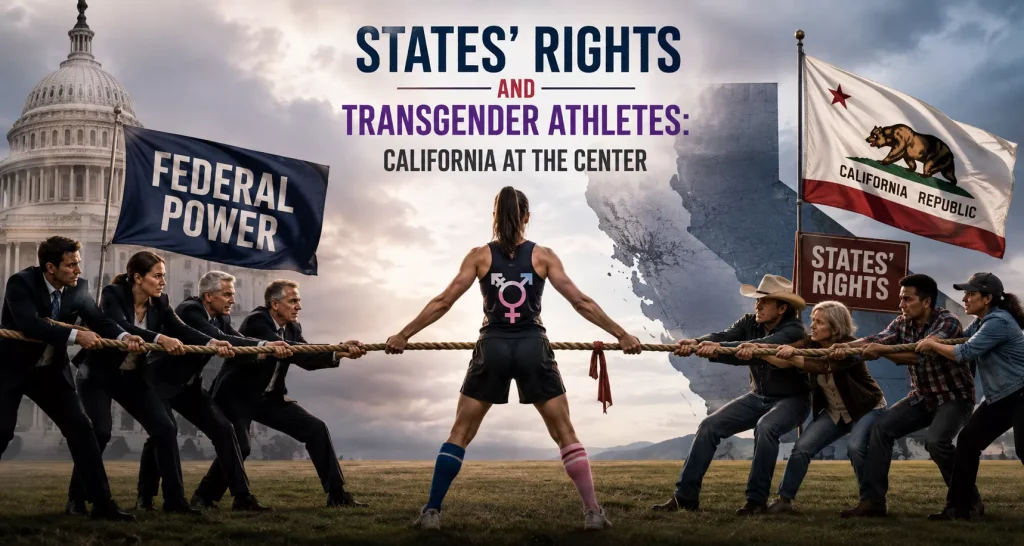
Three days ago, a federal judge in California threw out the Trump administration’s lawsuit demanding that the state bar transgender girls from girls’ school sports. I wrote about the ruling when it came down: Judge Cynthia Valenzuela held that Title IX does not require California to exclude anyone, and that Washington could not manufacture a mandate Congress never wrote. The legal reasoning matters. But so does a contradiction sitting in plain sight, and it deserves to be named.
For as long as I have been reporting, the Republican Party has sold itself as the party of states’ rights. The same GOP voices in general, and President Trump and his administration, in particular, have spent years vowing to shrink or abolish the Department of Education and “return education to the states.” It cheered when the Supreme Court sent abortion back to the states in 2022 and called it a triumph of self-government. The through-line was always the same: the federal government is too distant, too heavy-handed, to be trusted with decisions that belong closer to home.
Then California made a decision closer to home. It chose to let transgender students play. And the administration that preaches local control did not shrug and defer to the state’s judgment — it sued, reaching for federal law, federal courts, and the threat of federal funding to force California to reverse a choice its own citizens’ representatives had made. The party of “let the states decide” went to court to stop a state from deciding.
This is worth sitting with, because the underlying fight was never much of a fight. The panic over transgender athletes is, as I have argued before, largely a solution in search of a problem — a handful of college athletes, and teenagers who haven’t even reached puberty, turned into a national emergency. It is a long-running saga now, and strip away the noise and what remains is a genuinely small question that states are perfectly capable of answering for themselves, in different ways. That is exactly what federalism is supposed to allow.
The fair counterpoint deserves a hearing. Defenders of the lawsuit would say Title IX is itself a federal civil-rights statute, and enforcing a federal law is not the same as trampling a state — that Washington has always had a role in policing discrimination in schools that take federal money. That is a real argument, and on its own terms it is not hypocritical. But it gives the game away. If the principle is that federal civil-rights law controls, then the states’-rights sermon of the last several decades was never a principle at all; it was a preference for certain outcomes dressed up as one. You cannot spend a generation insisting Washington has no business in the schoolhouse and then send Washington into the schoolhouse the moment a state reaches a conclusion you dislike.
Because that is the tell. States’ rights, in this telling, are sacred when a red state bans something and negotiable when a blue state permits it. Local control is wisdom when it yields the preferred answer and tyranny when it does not. A principle that applies only when you win is not a principle; it is a tactic wearing the costume of one.
I do not expect perfect consistency from politics — few of us are consistent when the stakes feel personal. But it is worth saying plainly what this ruling exposed. A state looked at a small question, made a humane and lawful choice, and a federal government that claims to revere states’ rights tried to overrule it. The judge said no. For once the principle held — not because Washington honored it, but because a court made it. That, too, is part of the long argument over who gets to decide, and who only pretends to believe in letting them.
Common questions
What did the California court decide?
On September 2, 2026, U.S. District Judge Cynthia Valenzuela dismissed the Justice Department’s lawsuit and ruled that Title IX does not require California to exclude transgender girls from girls’ school sports.
Why is the case tied to debates over states’ rights?
The federal government sued to override California’s own policy choice — a move critics note sits in tension with long-standing conservative arguments that education and similar matters should be left to the states.
Is the ruling final?
Not necessarily. The Justice Department said it is evaluating an appeal, so the litigation may continue.
Continue Exploring
More in Politics
Explore by theme
See all in Politics