The politics of gender did not appear suddenly. They took shape across the twentieth century, era by era, as science, law, media, and social movements each reshaped how societies understood sex and identity. This page traces that history chronologically, highlighting the big shifts that moved the conversation from the medical clinic to the center of public life. It documents developments; it does not argue for a position.
This is a factual timeline focused on the United States and the broader Western context, with international milestones noted where they were decisive. It is necessarily selective: the aim is to mark the turning points, not to catalog every event.
Before 1900: the inherited assumptions
For most of Western history, sex and gender were treated as a single, fixed, and self-evident fact of nature, tied directly to the body and to sharply divided social roles. People who crossed those roles — in dress, work, or life — certainly existed and appear throughout the historical record, but they were understood through the language of morality, crime, or curiosity rather than identity. The twentieth century’s central shift was the slow replacement of that framework with a scientific and then a rights-based one.
1900s – 1930s
The first science and the first clinics
The modern study of gender variance began in Europe. In 1919, the physician Magnus Hirschfeld founded the Institut für Sexualwissenschaft (Institute for Sexual Science) in Berlin, which pioneered research on sexuality and gender and assisted some of the earliest documented gender-affirming surgeries. Among its patients was the Danish painter Lili Elbe, who underwent a series of surgeries in 1930–31 and became one of the first widely known cases. This early institutional foundation was abruptly destroyed in 1933, when the Nazi regime looted and burned the Institute’s library — one of the era’s starkest reminders that progress in this field has never been linear. A book and film were subsequently made about her life.
1940s – 1950s
Publicity and a new vocabulary
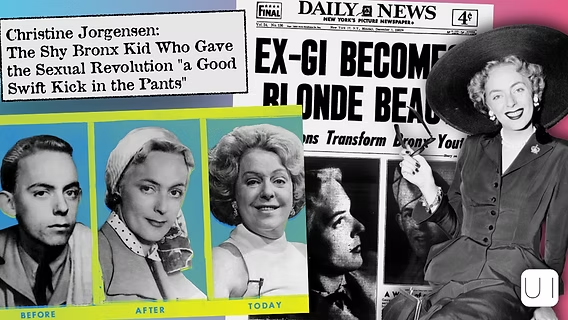
The mid-century brought the subject into mass public awareness for the first time. In 1952, Christine Jorgensen, an American who had traveled to Denmark for treatment, became a worldwide sensation — the first person whose gender transition was covered as front-page news. Her visibility gave millions of people a concept and a face for something most had never encountered publicly. In parallel, the physician Harry Benjamin began developing a clinical framework and popularized the term “transsexual,” using it publicly by 1957. The big shift of this era was cultural: transition moved from a private medical matter to a subject of national conversation. Other high-profile transitions that followed include Coccinelle of France, Bibi Fernandez of Spain, April Ashley of the U.K., and Tula (the Bond Girl).
1960s
Clinics, riots, and the roots of a movement
The 1960s fused medical legitimacy with the first stirrings of collective protest. In 1966, Harry Benjamin published The Transsexual Phenomenon, the first major medical text on the subject, and Johns Hopkins opened a university-based gender identity clinic — signaling institutional acceptance of transition as legitimate care. The same year, transgender women and drag queens resisted police harassment in the Compton’s Cafeteria riot in San Francisco, one of the first recorded instances of collective transgender resistance in the United States. Three years later, in June 1969, the Stonewall uprising in New York — in which transgender people and drag queens were central participants, among them Marsha P. Johnson and Sylvia Rivera — became the symbolic birth of the modern LGBTQ rights movement. The shift here was political: from isolated individuals to a nascent movement.
1970s
Organizing, backlash, and institutions
The 1970s saw both consolidation and conflict. Activist groups formed and dissolved; some early university clinics closed amid controversy; and a bitter dispute opened within parts of the feminist movement over whether transgender women should be included — a debate whose echoes persist. In 1977, a New York court ruled in favor of tennis player Renée Richards, who had been barred from competing as a woman, in an early and closely watched case about transgender participation in sport. In 1979, clinicians founded the Harry Benjamin International Gender Dysphoria Association — later renamed the World Professional Association for Transgender Health (WPATH) — and issued the first Standards of Care, giving transition-related medicine a formal professional framework. On the activist side, Marsha P. Johnson and Sylvia Rivera had founded STAR (Street Transvestite Action Revolutionaries) in 1970 to shelter homeless transgender youth, an early model of the community self-help that would define grassroots organizing for decades.
1980s
The diagnostic frame and the AIDS era
In 1980, the American Psychiatric Association’s DSM-III introduced formal diagnoses — “transsexualism” and “gender identity disorder” — which cut two ways: they legitimized access to care while also classifying gender variance as a mental disorder, a framing later generations would work to undo. The decade was dominated by the HIV/AIDS crisis, which devastated LGBTQ communities, reshaped activism toward urgent health advocacy, and often pushed transgender-specific concerns to the margins even within the broader movement.
1990s
Theory, an umbrella term, and the toll of violence
The 1990s gave the movement much of its current language. The word “transgender” spread as an umbrella term, notably through activist Leslie Feinberg’s 1992 pamphlet, uniting a range of identities under a single political banner. Academic “queer theory” reframed gender as partly socially constructed. Violence remained a grim constant: the 1993 murder of Brandon Teena drew national attention, and after the 1998 murder of Rita Hester, the annual Transgender Day of Remembrance was established in 1999. The shift was one of self-definition — the movement increasingly named itself, on its own terms.
2000s
Depathologizing, media, and creeping legal recognition
The new century brought steady, incremental change. In 2007 the professional body renamed itself WPATH, part of a broader move to separate transgender identity from the language of disorder. Employment nondiscrimination protections expanded in some states and cities; more jurisdictions allowed changes to identity documents; and transgender characters and public figures became more visible in mainstream media. The era’s shift was normalization — from spectacle toward ordinary civic and legal recognition, unevenly and jurisdiction by jurisdiction.
2010s
Mainstream visibility and organized backlash
Two opposing forces defined the 2010s. On one side, visibility surged: in 2013 the DSM-5 replaced “gender identity disorder” with “gender dysphoria,” shifting the diagnosis from identity to distress, and a wave of public figures and television brought transgender lives into the mainstream, captured by a 2014 magazine cover that declared a “transgender tipping point.” On the other side, a political backlash organized around specific flashpoints — most visibly the 2016 North Carolina law (HB2) restricting bathroom access, and recurring disputes over the military and school policies. The big shift was that gender identity became a front-line issue in national partisan politics.
2020s
The courts and an era of contestation
The current decade has moved the fight decisively into the courts and state legislatures. In 2020, Bostock v. Clayton County extended federal employment-discrimination protections to cover gender identity. In 2022, the World Health Organization’s ICD-11 took effect, formally removing gender incongruence from the mental-disorders classification. At the same time, dozens of states enacted laws addressing gender-affirming care for minors, participation in school sports, and related questions — and in 2025, in United States v. Skrmetti, the Supreme Court upheld a state ban on certain gender-transition treatments for minors. The defining feature of the 2020s is contestation: expanding recognition in some arenas and sharp new restrictions in others, often at the same time.
International milestones
Although this timeline centers on the United States, several developments abroad shaped the global conversation and are worth noting as reference points:
- United Kingdom, 2004 — the Gender Recognition Act created a legal process for changing one’s recognized gender, an influential early model that later became a flashpoint in its own right.
- Argentina, 2012 — the Gender Identity Law allowed people to change their legal gender based on self-declaration, without medical or judicial approval, and became the reference point for “self-identification” laws worldwide.
- India, 2014 — in the NALSA judgment, the Supreme Court legally recognized a third gender and affirmed the rights of hijra and transgender people.
- World Health Organization, 2019/2022 — the ICD-11 reclassification, agreed in 2019 and effective in 2022, set a global medical standard that no longer treats gender incongruence as a mental disorder.
These milestones did not move in a single direction, and several of the same countries later saw intense political contestation over the very laws listed here — a reminder that recognition, once granted, is not necessarily permanent.
Reading the arc
Viewed across the century, a few patterns recur. Understanding moved from morality to medicine to identity and rights. Progress arrived in waves, each met by backlash, and gains in one arena often coincided with losses in another. And the arena of decision shifted over time — from the clinic in the early twentieth century, to the streets and the culture at mid-century, to the courts and legislatures today. None of this settles the underlying questions, which remain genuinely contested. It simply shows how the present debates were built, one era at a time.
For definitions of the terms used above, see the Terminology guide. For the broader conceptual background, see the Gender guide.
Frequently asked questions
When did the modern study of gender begin?
The modern scientific study of gender variance is usually traced to Magnus Hirschfeld’s Institute for Sexual Science, founded in Berlin in 1919, which conducted early research and assisted some of the first documented gender-affirming surgeries. The Institute was destroyed by the Nazi regime in 1933.
Who was Christine Jorgensen?
Christine Jorgensen was an American whose gender transition, following treatment in Denmark, became front-page news worldwide in 1952. She was the first person whose transition received mass public attention, and she gave the general public an early, widely recognized reference point for the subject.
Was Stonewall a transgender event?
The 1969 Stonewall uprising in New York is regarded as the symbolic start of the modern LGBTQ rights movement, and transgender people and drag queens were among its central participants. An earlier instance of collective transgender resistance was the 1966 Compton’s Cafeteria riot in San Francisco.
When did “transgender” become the common term?
“Transgender” spread as an umbrella term during the 1990s, uniting a range of identities under one political banner — a usage popularized in part by activist Leslie Feinberg’s 1992 pamphlet. Earlier decades more often used “transsexual,” a narrower medical term.
How has the medical classification changed?
Formal diagnoses first appeared in the DSM-III (1980). In 2013 the DSM-5 replaced “gender identity disorder” with “gender dysphoria,” shifting the focus from identity to distress. In 2022 the World Health Organization’s ICD-11 removed gender incongruence from its mental-disorders chapter entirely.
Why is gender such a prominent political issue now?
Gender identity moved to the center of national politics during the 2010s and 2020s, as rising public visibility met an organized backlash focused on flashpoints such as bathroom access, school sports, and medical care for minors. Much of the current activity has shifted into the courts and state legislatures, including the Supreme Court’s 2020 Bostock decision and its 2025 Skrmetti decision.
Sources and further reading: standard histories of transgender and LGBTQ movements; American Psychiatric Association DSM-III (1980) and DSM-5 (2013); World Health Organization ICD-11 (in effect 2022); Bostock v. Clayton County (2020); United States v. Skrmetti (2025). Dates reflect the historical record as of this writing.
Common questions
What does the History section cover?
The people, milestones, and movements that shaped transgender history — from early figures to the present day.
Why does transgender history matter?
Knowing this history gives context to today’s conversations and recognizes lives that were long left out of the record.
Related Commentary
Commentary is where Brianna weighs in on news stories, essays, interviews, reviews, upcoming or past events, and site news. A few recent pieces to read alongside the library are listed below.
A Practical Guide to Coming Out
Coming out is more than a single announcement—it is a profound, lifelong path. This guide helps you navigate the emotional, personal, and social realities…
The Words of Others
The words of others don’t define me. How could they? In many instances, those “others” don’t even know me. They see me and then…
States’ Rights, Until a State Disagrees
Republicans have long championed states' rights on education and beyond — until California chose to protect transgender athletes, and Washington sued to overrule it.