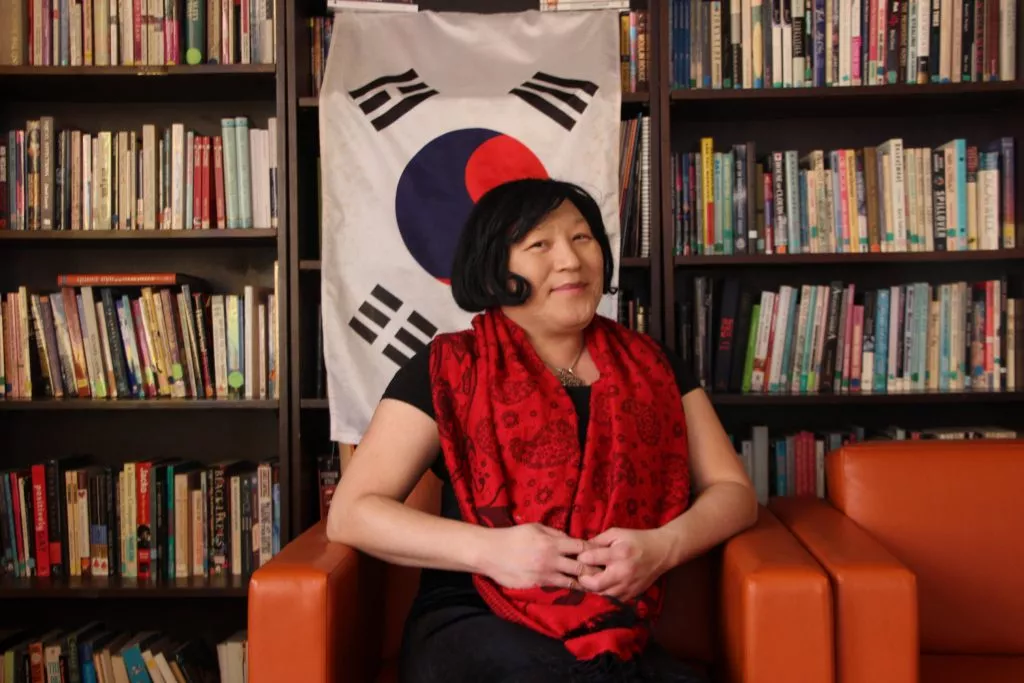
Intelligent, well-spoken, poised, confident, and comfortable as a transgender woman, Pauline Park is driven to make a difference and has been a lightning rod for social change.
As an orphan born in Korea during a year of revolution, Pauline was adopted and raised in the Midwest. She did her master’s degree at the London School of Economics. She later studied German in Berlin and in Regensburg, where she lived in a medieval tower in the ancient heart of that Bavarian city.
Park did her dissertation research in Brussels and Paris for her Ph.D. in political science from the University of Illinois at Urbana-Champaign. She came out as an openly transgender woman after moving to New York City.
Park co-founded Queens Pride House (a center for the LGBT communities of Queens) in January 1997 and Iban/Queer Koreans of New York (Iban/QKNY) in February 1997. In June 1998, she co-founded the New York Association for Gender Rights Advocacy (NYAGRA), the first statewide transgender advocacy organization in New York, leading the campaign for passage of Int. No. 24 — the transgender rights ordinance enacted by the New York City Council as Local Law 3 of 2002. In July of that year, she co-founded the Guillermo Vasquez Independent Democratic Club of Queens (GVIDCQ).
She initiated inclusion of gender identity and expression in the Dignity for All Students Act (DASA), a safe schools bill currently pending in the New York State Legislature, and serves on the steering committee of the coalition that secured enactment of the Dignity in All Schools Act by the New York City Council in September 2004.
Park serves on the board of directors of the Transgender Legal Defense & Education Fund (TLDEF) and on the advisory board of Asian
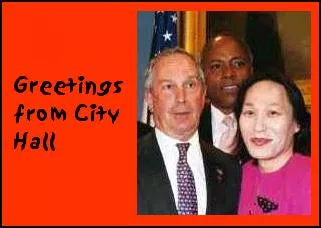 Pacific Islanders for Human Rights (APIHR). She has written widely on LGBT issues and has conducted transgender sensitivity training sessions for a wide range of social service providers and community-based organizations. She helped found the Out People of Color Political Action Club (OutPOCPAC) in April 2001 and, in 2006, became the first openly transgender individual chosen as a grand marshal of the New York City Pride March.
I first met Pauline Park in the summer of 2001. She presented at an open GLBT forum hosted at the Bar Association of New York, and I was there to cover the event for Girl Talk Magazine. She left a strong impression on me: intelligent, well-spoken, poised, and comfortable being a transgender woman. We’ve known each other for years and have talked many times about doing an interview. Finally, we had the opportunity to fulfill that wish during a long-distance phone call. Here are excerpts of that interview:
Park helped shape the era covered in our Transgender History & Education section.
Brianna
How does Pauline Park talk about gender and transition?
How do you define your gender?
Pauline: I identify as a transgender woman as well as a male-bodied woman. For me, being a woman has to do with gender, whereas being a female has to do with anatomical sex.
Being a “male-bodied woman,” and not planning surgical transition, how do you deal with the constant battle of being seen as legally male?
On a personal level, I simply deal with situations as they arise. As an activist, I see my work as challenging and dismantling the sex/gender binary in all of its manifestations, including the ways in which legal sex designation as male or female limits one’s access to employment, housing, public accommodations, health care, and travel.
How do you feel about SRS and other surgeries?
Whatever makes people more comfortable with themselves is fine, but I think that there are people in the transgender community who think sex reassignment surgery (SRS) is going to make them happy, rather than finding happiness within themselves first and then getting SRS to simply become more comfortable in their skin. I do worry about those who take surgery to an extreme, becoming addicted to plastic surgery and attempting to completely reshape their faces and bodies.
Do you encounter much resistance from society by your presentation of self?
Mostly not, but I’ve occasionally been questioned at airports because my government-issued ID lists my male name and a male legal sex designation, creating an apparent discrepancy between my presentation and my ID. But when they question me, I simply tell them I’m a transgender woman.
How do you respond to those who say the trans community is not entitled to special treatment because being transgender is a conscious choice?
I don’t know anyone who feels they consciously chose to be transgender, but whether it is or not is not relevant to the question of transgender rights. After all, the Constitution and the Bill of Rights protect freedom of religion, even though religious affiliation is clearly a matter of choice. In the US legal system, we protect many things that are not immutable characteristics.
What can trans history teach the movement?
As students of history, what can we learn that may prepare us for the future?
History shows us that people like us have always existed in both pre-modern Western and non-Western societies. But there are those who exaggerate continuity with regard to transgender identity, claiming that there is a common and easily traced ‘transgender history’ that we share with people from very different cultures and time periods; an example of this would be Leslie Feinberg’s appropriation of Joan of Arc as a transgender figure in “Transgender Warriors.” Joan of Arc was not burned at the stake simply for wearing the armor of a male soldier, and writing her story as if it were only a case of gender transgression is misleading and makes for bad history. But there are also those who exaggerate discontinuity, those who claim that transgendered people have only existed for less than half a century. There were people like us in the past, but the form that we would call ‘transgender’ identity varies across cultures and time periods. Nonetheless, one can find a ‘third sex/third gender subject position’ in virtually every culture, even if the way people we would call transgendered express themselves differently in each.
Trans issues are in the news a lot these days. Is that a good thing?
Being invisible never helped us, so visibility is better. Although the transvestite serial killer news stories (or movies) don’t help. But it is dangerous for any one individual or any one segment of a group to speak for the entire community. It is especially dangerous to speak as if transgender is a mental illness, albeit an ostensibly curable one. There are transgender women who say “I was born with a birth defect,” but that’s an appalling way to think about gender identity. Media coverage tends to be focused on the classic transsexual transition narrative, as in, “I feel like a woman trapped in a man’s body.” They go on to suggest that with surgery they can correct their ‘birth defect’ and be just like other women. This constructs transgender people through a medical model, which is in fact a disease model. Should we as a community pursue assimilation into the mainstream by trying to elicit sympathy for a supposed ‘birth defect,’ or do we say, “Yes, we’re different, and what’s wrong with that?” There is an infinite universe of possible gender identities, so why are we trying to fit into a rigid sex/binary system? I believe that it is that binary system that is the root of our oppression as transgender and gender-variant people.
Are there other factors that impede trans equality?
Yes, and that is the inclusion of the diagnosis of gender identity disorder (GID) in the Diagnostic & Statistical Manual of Mental Disorders (DSM-IV) published by the American Psychiatric Association (APA). The implication of the GID diagnosis is that transgender — and indeed any form of gender variance — is a mental illness. Unfortunately, GID is also used in order to pursue transgender discrimination suits under the rubric of disability; but when a transgender discrimination claim is made under disability law (based on a diagnosis of GID), it reinforces the false notion that transgender is a mental pathology, which makes it harder to move forward our equal rights agenda through legislation.
How did Pauline Park become an activist?
How and when did you become engaged with activism & advocacy work?
My involvement with activism began in 1994 with the LGBT/queer API Asians & Pacific Islanders) community and has spiraled from there. I decided early on that I wanted to expend my energy being involved and bringing social change in a positive way.
You stated that there are structural impediments and personal prejudice that trans people have to navigate in our society. Can you elaborate?
Virtually every identity document includes only one choice for name and only two choices for sex. The very first thing one has to do upon entering a hospital or a clinic is to fill out a form that also has only one choice for name and only two choices for sex. These are only a few of the many structural impediments to transgender people. Another is the lack of laws that explicitly protect transgender people in most cities and states. Another is the sex segregation of public facilities such as restrooms, locker rooms, and homeless shelters, as well as jails and prisons. Segregation by legal sex designation, not by gender identity, can be not only inconvenient but life-threatening in certain contexts.
What do you want to achieve as an activist?
I would like to see [the community] become a movement focused on social justice and social change, addressing socio-economic issues like poverty, healthcare, education, and employment, as well as challenging and dismantling the sex/gender binary.
When do you think it can — or will — be obtained?
It’s difficult to predict, but I think this will take decades.
Does political change drive social change?
Does political change bring social change, does social change drive legal change, or do they happen simultaneously?
Legal change and social change should be pursued simultaneously. One should use legal change to advance social change, and vice versa. For example, we in NYAGRA used the campaign to educate the public, policymakers, and the media about discrimination faced by transgender people; at the same time, we took every opportunity to educate the public and build support for the bill.
Is the Transgender movement just a natural evolution of earlier movements, like the equal rights movement of the 60s or the gay rights movement of the 70s?
The transgender movement is certainly a movement for equal rights and in that respect shares similarities with the gay & lesbian movement, the women’s movement, and the African American civil rights movement, among others. And though the transgender rights movement has already begun to follow a similar trajectory as the gay & lesbian movement, there are and will continue to be some differences in its development. As a community and as a movement, we should learn from the successes and failures of other movements before us.
What do you see that the trans rights movement needs to learn from the gay rights movement and do differently?
We certainly need to attain full equality under law, but we also need to understand that obtaining juridical rights will not eliminate transgenderphobia, no more than gay rights laws have eliminated homophobia or civil rights laws prohibiting discrimination based on race have eliminated racism. Equality under law is necessary but not sufficient to achieve full equality in this society.
In my essay “Boxes“, I wrote that they (Boxes) can be a beacon of light for those lost, and yet divide others. Do you see them as helpful or hurtful?
As human beings, we are naturally taxonomic creatures, and we label each other in regard to everything: race, ethnicity, sex and gender, but also age, height and weight, etc. People don’t just have blond hair; some people are labeled (or even self-identify as) ‘blondes.’ At the same time, categorizing someone limits them to that label, and that can be damaging. So first, it’s important to understand that every label is a relatively arbitrary social construct and has no meaning beyond what we assign to it.
Speaking of labels, people are always debating whether, as a trans woman, they are gay or straight based on relationships with men and women. How do you see that?
It troubles me that some trans women feel the need to insist that they are heterosexual because they are post-op and attracted to men. Why is that important? Why do they feel the need to be heteronormative? We will never empower the community as a whole without
challenging and dismantling structures of heteronormativity, because someone will always fall outside whatever lines we draw.
What can the trans community do for itself?
What can we do within the community to help ourselves?
Within the community itself, we spend so much time and energy on silly arguments like who is more real, transsexuals or crossdressers, and that distracts us from going forward. Is one person more ‘real’ than another? It seems like a silly way of thinking about transgender identity. It also troubles me that some transgender people want to just assimilate into society rather than pursuing social justice and social change.
Pauline, it was a delight talking with you, and I wish you all the best in your efforts
Thanks, and it was a pleasure, Brianna.
Visit Pauline’s website Here
Related reading
Explore more interviews, the LGBTQ history reading guide, and the history reference library.